Fall Along the Hudson: Reading the River Valley in October
Why this valley is such a fine place to watch autumn arrive, from the pigments in a single leaf to the hawks overhead.
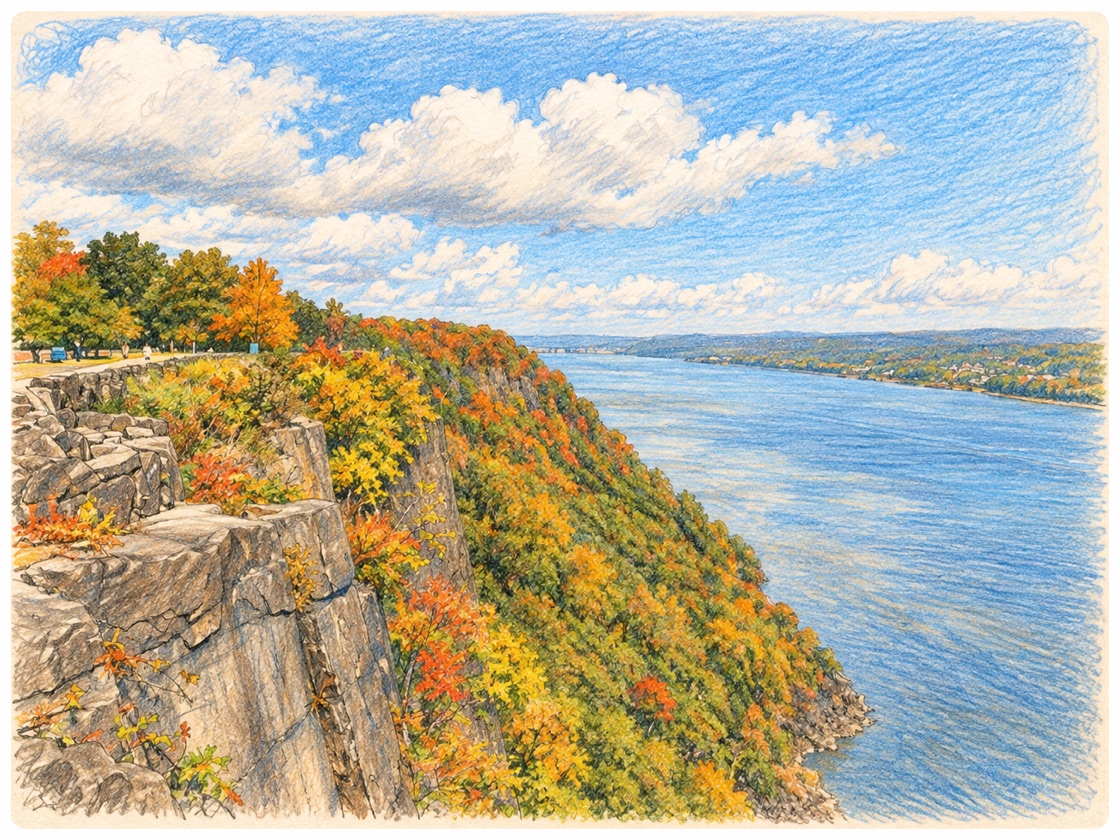
Illustration based on a photo by Famartin / Wikimedia Commons (CC BY-SA 4.0)
Every October, the Hudson Valley invites a particular kind of attention. The foliage changes by the day and the light slants lower across the river. It helps to know a little about what you are seeing, because the valley is an unusually good place to read autumn, both in the trees and in the sky above them.
Begin with the science, which is more interesting than the usual shorthand of "leaves turning." Through the growing season, the green of a leaf comes from chlorophyll, the pigment that captures sunlight for photosynthesis. Chlorophyll is not permanent. The tree keeps rebuilding it all summer, and as nights lengthen in autumn, that production winds down and the existing chlorophyll breaks apart. What was hidden is then revealed. The yellows and oranges of carotenoids were present in the leaf all along, simply masked by the green. As the Northern Virginia Soil and Water Conservation District explains in its overview of fall leaf color, carotenoids are tough molecules that also help protect leaf tissue as chlorophyll degrades.
The reds and purples are a different story. Those come from anthocyanins, pigments that, unlike carotenoids, are largely manufactured in autumn, and that tend to build up as a response to bright light and sugars lingering in the leaf. Maples are famous for them. This is also why the quality of a season depends on the weather. Cool nights combined with bright, sunny days give a tree both the stress and the energy to intensify its pigments, and the result is the saturated display that people travel to see. So crisp mornings and clear afternoons are good news for the color to come.
Geography does the rest. Along the Palisades, the cliffs rise directly from the water, and the trees clinging to their edge catch the low light across the river. In the Highlands, ridges stack one behind the other, so a single view can hold many shades at once.
You do not need to travel far to see it. The Old Croton Aqueduct State Historic Park preserves 26.2 miles of the original 41-mile aqueduct, which carried water to New York City starting in 1842, and it passes through Ossining and Dobbs Ferry on its way. It is a wonderful way to take in the changing canopy at a walking pace. Teatown Lake Reservation in Ossining protects and manages more than 1,300 acres, and its trails are open daily from dawn to dusk, a good option for those who prefer woodland to a long, straight path. Croton Point Park offers open sky and shoreline brush, and it rewards anyone who brings binoculars.
The second half of the story is overhead. The valley sits along a major migration corridor, and autumn is when it is busiest. Hawks follow the ridgelines, riding the rising air along the cliffs, and the Hook Mountain hawk watch in Nyack, just across the river, is one of the best places to see them. The Audubon Society estimates that an average of more than 12,000 hawks fly past Hook Mountain each fall, including sharp-shinned, Cooper's, broad-winged, and red-tailed hawks.
Then there are the birds you will rarely see in flight at all. Most songbirds migrate at night, which means the sparrows and warblers you notice in the brush at dawn may have just finished a long journey. Cornell's BirdCast, which follows migration on radar, forecast about 408 million birds taking flight across the contiguous United States on a single night in mid-October 2020. Among the travelers of this season are white-throated sparrows, kinglets, and yellow-rumped warblers. That last species can digest the wax on bayberry and wax myrtle berries, which lets it winter farther north than its relatives.
If you want to put all of this into practice this week, the calendar is generous. A morning on the aqueduct trail or at Teatown pairs naturally with Sunday's Hispanic Heritage Festival at the Paramount in Peekskill, which runs from noon to 6pm. And Lyndhurst and Untermyer Gardens both offer their last tours of the season on October 31, while the color is still at its best.
Autumn here is not a single event but a slow conversation between the weather, the light, the rock, and the water, with the birds moving through it. Take a little extra time this week to listen in.
Get the Weekly Newsletter
Local events, jobs, and community news, every Thursday morning.
Free. No spam. Unsubscribe any time.